Home Planning & Renovations
What to Expect When You Hire a General Contractor in Manhattan & Brooklyn
By Ofek Dahan
If you’re ready to hire a general contractor NYC homeowners trust, understanding the full process—from first conversation to final warranty—will save you time, money, and stress. This guide walks you through every stage so you know exactly what to expect before signing a contract.
At a glance
- Schedule a free consultation — a Renovation Expert assesses your space and gives you a realistic budget range at no cost.
- Get an itemized proposal — labor, materials, and likely extras are priced upfront so you understand the full scope before signing.
- Let your contractor handle permits and board approvals — a reputable NYC firm files DOB applications and submits alteration agreements on your behalf.
- Work with a dedicated Project Manager — one point of contact oversees construction, provides weekly reports, and manages change orders transparently.
- Receive a written warranty — MyHome backs completed work with a 10-year written warranty for lasting peace of mind.
Why Hiring the Right General Contractor Matters in NYC
Short answer: NYC renovations involve city permits, co-op or condo board approvals, and coordination challenges that don’t exist in most markets. The contractor you choose determines whether these hurdles disappear or derail your project.
Renovating in Manhattan or Brooklyn isn’t like renovating anywhere else. Your project will likely require permits from the NYC Department of Buildings. If you live in a co-op or condo—and most of our clients do—you’ll also need your building’s board to approve an alteration agreement before any work begins. According to the NYC Department of Buildings, most renovation work that affects plumbing, electrical systems, or structural elements requires a permit.[^1]
A contractor who knows this landscape handles both processes on your behalf. One who doesn’t will leave you navigating bureaucracy alone—and that’s where timelines collapse.
At MyHome, we take full responsibility for DOB filings and building-board submissions so you never interface with either. In 25 years of renovating Manhattan and Brooklyn homes, we have never been turned down by a residential building’s board. That’s not a guarantee for your specific building—every board makes its own decisions—but it reflects a track record built on complete, professional packages that boards approve without friction.
The Hidden Gatekeepers — DOB and Building Boards
Most renovations that touch plumbing, electrical, or structural elements require a DOB permit. Co-ops and condos add another layer: the alteration agreement. This document outlines your scope, your contractor’s insurance, and the protections your building requires.
Failures at either gate stall projects for months. The right contractor prevents those failures by knowing exactly what each authority needs.
Stage 1 — The Free Consultation
Short answer: Your first meeting is a site visit where a Renovation Expert assesses your space, discusses your goals, and gives you a realistic sense of scope and budget—at no cost.
Before any design work begins, you need to know whether your vision is feasible. That’s the purpose of the free consultation.
When you schedule a consultation with MyHome, you’ll meet with a Renovation Expert who walks your space, listens to what you want, and identifies any structural or building-specific constraints. You’ll leave with a clearer picture of what’s possible and a preliminary budget range—not a final quote, but enough information to decide whether to move forward.
Questions to Ask During Your First Meeting
Use this time to vet the contractor, not just describe your project:
- How long has your company been in business?
- Are you licensed and insured in New York City?
- Do you handle DOB permits and board approvals, or is that my responsibility?
- What does your warranty cover, and for how long?
- How do you handle change orders if unexpected issues come up?
- Who will be my main point of contact during construction?
The answers reveal whether you’re talking to a professional operation or a contractor who will disappear when problems arise.


Stage 2 — Design Development and Proposal
Short answer: After the consultation, you’ll work with a designer to finalize your plans and receive an itemized proposal that prices likely extras upfront—so surprises don’t become budget blowouts.
Once you decide to proceed, the project moves from your Renovation Expert to a dedicated Designer. This handoff is intentional: your Designer focuses entirely on translating your goals into detailed plans and specifications.
The deliverable at this stage is an itemized proposal. Unlike a lump-sum bid that hides details, an itemized proposal breaks down every cost: labor, materials, permit fees, and a line for contingency. Critically, it also prices likely extras—things like permit costs, plumbing riser work, or subfloor replacement—before you sign.
We call this approach “transparent upfront.” You know the realistic budget before committing.
What an Itemized Proposal Should Include
- Labor costs by trade (demolition, carpentry, plumbing, electrical, tiling)
- Material allowances or specified products
- Permit and filing fees
- Likely extras priced as line items
- Payment schedule tied to milestones
- Projected timeline with key dates
Red Flags in Contractor Estimates
Be cautious if a bid:
- Offers only a single lump-sum number with no breakdown
- Omits permit fees or says “permits as needed”
- Has no written policy for handling mid-project changes
- Quotes a suspiciously low number with vague language about “adjustments”
What a detailed scope looked like on recent MyHome jobs
Tub-to-shower bathroom at 201 West 74th Street, Upper West Side: the schedule was written before the job started and given to the building, week by week: demolition in week one, rough plumbing in weeks two and three, waterproofing in week six, tile in week seven, through to touch-ups in week eleven.
Bathroom at 510 West 123rd Street, Morningside Heights: the scope carried a protection list almost as long as the demolition list, down to two grab bars: one listed for removal and one to be protected and kept.
How to Hire a General Contractor NYC Homeowners Can Trust
Short answer: A reputable contractor files your DOB permits and submits your alteration agreement so you never deal directly with city agencies or your building’s management.
Stage 3 is where many DIY-managed renovations stall. NYC’s permit process involves applications, plan reviews, and inspections. Co-op and condo boards require alteration agreements, proof of insurance, and sometimes interviews.
MyHome handles all of this. We prepare the complete DOB filing package and coordinate with your building’s management company to submit a professional alteration agreement. You sign where needed, but we do the legwork.
Co-op vs. Condo — What’s Different?
Co-op boards tend to be more hands-on. They may require a board interview, higher insurance limits, and stricter working-hour rules. Condo boards typically approve projects through the managing agent without an interview, though insurance and noise requirements still apply. As Habitat Magazine explains in its coverage of NYC residential renovations, co-op proprietary leases often grant boards broader discretion over alterations than condo bylaws typically allow.[^2]
The paperwork differs, but the principle is the same: a complete, professional package gets approved; an incomplete one gets rejected or delayed.
Timeline Expectations for Approval
Most board approvals take four to eight weeks, though some buildings move faster and others slower. Delays usually stem from missing documents—proof of insurance, incomplete drawings, or unsigned neighbor agreements. An experienced contractor submits complete packages the first time, avoiding the back-and-forth that adds weeks.
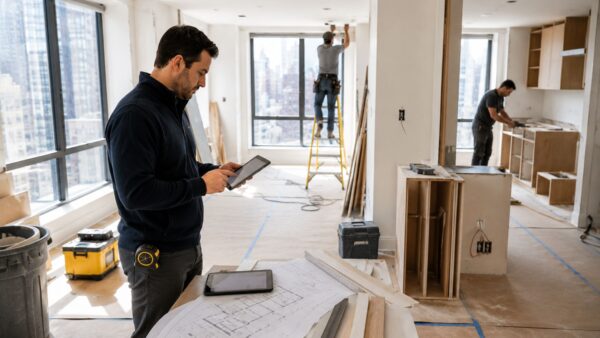

Stage 4 — Construction and Project Management
Short answer: During construction, a dedicated Project Manager oversees your job, provides weekly written reports, and ensures any mid-project surprises are shown to you and priced before work proceeds.
When construction begins, your point of contact shifts again—from Designer to Project Manager. This isn’t a hand-off that leaves you confused; it’s a deliberate relay. Your PM knows the job inside and out because they’ve been briefed by the team that designed it.
Your PM is on-site regularly, coordinates the crew, and gives you weekly written reports on progress. You always know where the project stands without chasing anyone down.
How Change Orders Should Work
Renovations uncover surprises: outdated wiring behind walls, water damage under floors, plumbing that doesn’t meet current code. How your contractor handles these moments matters more than any other part of the relationship.
At MyHome, the protocol is simple:
- Work stops when we discover something unexpected.
- We bring you to the site (or send photos and video) so you see exactly what we found.
- We explain why it needs to be addressed and provide the exact price.
- You sign off on the change order.
- Only then does work proceed.
We never replace first and bill later. This approach keeps you in control and prevents the invoice shocks that ruin contractor relationships.
Communicating With Your Contractor During the Build
Best practices for a smooth construction phase:
- Maintain a single point of contact (your PM) for all decisions
- Document every change in writing—even small ones
- Schedule regular check-ins rather than ad-hoc texts
- Visit the site when invited, but trust the process between visits
What opening the walls found on a recent MyHome job
Pre-war galley kitchen and laundry at 1192 Park Avenue, Upper East Side: corroded brass and copper waste and supply at a wall penetration had to come out and be re-run before any finish could start, which is what decided the schedule. The job ran about thirteen weeks on site.
Stage 5 — Final Walkthrough and Warranty
Short answer: At project completion, you’ll do a punch-list walkthrough to catch any remaining details, and you’ll receive a written warranty that protects your investment for years.
The final walkthrough is your opportunity to inspect every surface, fixture, and finish. Your PM will walk the space with you, note any punch-list items, and schedule their completion.
Once punch-list work is done, your renovation is complete—but your protection isn’t over. MyHome provides a 10-year written warranty on our work. For full warranty details, visit our warranty page.
What a Warranty Should (and Shouldn’t) Cover
Warranties typically cover defects in workmanship and installation. They generally do not cover wear and tear, damage caused by the homeowner, or manufacturer defects in products (which are covered by the manufacturer’s warranty). Always confirm the specifics in writing before signing your contract.

How Much Does Hiring a NYC General Contractor Cost?
Short answer: Labor costs for a full renovation typically range from $120,000 to $150,000; kitchen remodels run $30,000 to $35,000 for labor; bathrooms range from $32,000 to $35,000—though final costs depend on scope, materials, and building requirements.
You may have seen $/sq-ft figures quoted online. Be careful: those numbers often reflect new construction or national averages, not NYC renovation labor. Renovation work—especially in occupied co-ops and condos with strict building rules—costs more per square foot than building from scratch because of access constraints, protection requirements, and phased scheduling.
The labor ranges above are calibration points, not fixed quotes. Your actual cost depends on:
- Project scope (cosmetic refresh vs. gut renovation)
- Building requirements (insurance, working hours, freight elevator rules)
- Plumbing and electrical complexity
- Material selections (we can source materials for you or you can supply your own)
- Permit and filing fees
A detailed consultation gives you a realistic budget before you commit.
Factors That Influence Your Final Price
| Factor | Impact |
|---|---|
| Scope | Gut renovations cost more than cosmetic updates |
| Building rules | Strict co-ops add insurance and coordination costs |
| Plumbing/electrical | Moving fixtures or upgrading panels adds labor |
| Materials | High-end finishes increase overall budget |
| Permits | Some projects require expedited filings |
Checklist — Choosing a General Contractor in Manhattan or Brooklyn
Before you sign, confirm:
- 25+ years of experience in NYC renovations
- Written warranty (ask for the term and what it covers)
- Clear change-order protocol in the contract
- Track record with co-op and condo board approvals
- Itemized proposal, not a lump-sum bid
- Single Project Manager accountable for your job
- Licensed and insured in New York City
Frequently Asked Questions
What does a general contractor actually do during an NYC renovation?
A general contractor manages every aspect of your project: hiring and coordinating subcontractors, ordering materials, pulling permits, scheduling inspections, and ensuring work meets code. In NYC, they also handle board approvals for co-ops and condos.
How long does a typical Manhattan or Brooklyn renovation take?
Timelines vary by scope. A bathroom remodel may take 6–8 weeks; a kitchen, 8–12 weeks; a full-home gut renovation, 4–6 months or more. Board approval adds 4–8 weeks before construction begins.
Do I need board approval for my co-op or condo renovation?
Almost always, yes. Even cosmetic work may require notification. Any project involving plumbing, electrical, or structural changes will require a formal alteration agreement.
How do I know if a NYC contractor is licensed and insured?
Ask for their license number and verify it with the NYC Department of Consumer and Worker Protection. Request a certificate of insurance and confirm coverage amounts meet your building’s requirements.[^3]
Ready to Start Your Manhattan or Brooklyn Renovation?
You now know exactly what to expect when you hire a general contractor NYC homeowners count on for co-ops, condos, and townhomes. The process doesn’t have to be opaque or stressful—not when you work with a contractor who handles permits, boards, and construction under one roof.
Schedule your free consultation with MyHome today. We’ll walk your space, discuss your goals, and give you a realistic sense of budget and timeline—no obligation, no pressure. Let’s build something worth coming home to.
Sources
[^1]: NYC Department of Buildings. “Homeowner Information.” Accessed 2024. https://www.nyc.gov/site/buildings/homeowner/homeowner.page
[^2]: Habitat Magazine. “Renovation & Construction Coverage.” https://www.habitatmag.com/
[^3]: NYC Department of Consumer and Worker Protection. “License Verification.” https://www.nyc.gov/site/dca/businesses/license-verification.page

Ofek Dahan
Ofek Dahan is the CEO of MyHome Renovation Experts, dedicated to delivering exceptional remodeling experiences through thoughtful design, quality craftsmanship, and transparent communication. He shares insights on renovation planning, industry trends, and creating homes that are both beautiful and functional for modern NYC living.
Related Posts

How to Shortlist Full-Service Firms for a Brooklyn Heights Co-op Renovation Before You Request Quotes
A pre-quote screening method for Brooklyn Heights co-op owners: evaluate renovation firms for relevant experience,...

Who Handles an NYC Apartment Renovation From Design Through Board Approval and Construction?
See what an end-to-end NYC apartment renovation partner should handle—from design and board packages to...

What Happens at a Designer-Guided NYC Renovation Showroom Appointment?
Overwhelmed by tile, stone, cabinets, and fixtures? Learn what to bring to a designer-guided NYC...