Home Planning & Renovations
What Accountability Actually Looks Like in an NYC Renovation (After a Bad Contractor Experience)
By Yoel Piotraut
NYC renovation contractor accountability is the difference between a project that transforms your home and one that becomes a cautionary tale. If you’ve been burned by a contractor who disappeared mid-project, surprised you with charges after the work was done, or simply stopped returning your calls, you already know that “accountability” on paper means nothing without behaviors you can observe.
Whether you’re renovating a pre-war co-op on the Upper West Side or a Brooklyn brownstone, this guide breaks down what accountability actually looks like — the specific structures, communication patterns, and policies that separate reliable renovation firms from the ones that leave homeowners stranded.
At a glance
- Know who you’ll work with before you sign — named contacts with defined roles eliminate the “I didn’t know who to call” problem that defines bad contractor experiences.
- Expect written updates weekly, without asking — proactive communication with photos and milestones creates a record and keeps you informed.
- Require written approval before any extra work — a “transparent upfront” change-order process protects you from surprise charges.
- Verify your contractor can handle your building — in NYC co-ops and condos, board approval and managing-agent coordination matter as much as the work itself.
- Look for longevity and repeat customers — firms that don’t deliver accountability don’t survive 25 years in a referral-driven market.
Why “Accountability” Is the Wrong Word — Until You Define It
Short answer: Accountability isn’t a promise in a contract — it’s a set of observable behaviors. Before you sign with any renovation firm, you should be able to see how they communicate, who you’ll work with, and what happens when something changes.
Every contractor claims to be accountable. The word appears in marketing materials, contracts, and sales conversations. But for homeowners who’ve been through a bad renovation — whether in Chelsea, the Upper East Side, or Park Slope — the word has lost all meaning.
The problem is that “accountability” has become a feeling contractors want you to have, not a structure they’ve built into their process. Real accountability is specific. It answers three questions before you sign:
- Who exactly will I talk to? Not “the office” or “someone from our team” — actual names and roles.
- How will I know what’s happening? Not “we’ll keep you updated” — a defined communication schedule you can count on.
- What happens when something changes? Not “we’ll work it out” — a policy that protects you from surprise charges.
If a contractor can’t answer these questions concretely during your first conversation, their accountability exists only in their marketing.
The Three Accountability Failures That Define Bad Contractor Experiences
When homeowners describe contractor horror stories, the same patterns repeat:
No single person to contact. You call the office, leave a message, and wait. You text the number you were given and get a response three days later from someone you’ve never heard of. When something goes wrong, there’s no one who owns the problem.
No proactive updates. You’re the one chasing information, calling to ask what happened this week, wondering if the project is on track. Silence becomes the norm, and silence breeds anxiety.
Surprise charges after work is done. The contractor decides something needs to change, does the work, then presents you with a bill. You never agreed. You never even knew it was happening. But now you’re expected to pay.


NYC Renovation Contractor Accountability Starts with Named Contacts
Short answer: You should know the name and role of every person you’ll work with before construction begins. A healthy structure includes clear handoffs — not random reassignments — so you’re never wondering who’s responsible for your project.
The most common complaint from burned homeowners isn’t about tile work or cabinet quality. It’s this: “I didn’t know who to call.”
A reliable renovation firm structures your project around specific people with defined roles. You should know who handles your initial consultation, who guides your design decisions, who manages construction, and when each person enters and exits your project.
One effective model is a three-person relay: a Renovation Expert handles your consultation and proposal, a Designer guides material and fixture selections, and a Project Manager leads from the construction kickoff through completion. Each handoff is intentional. You’re introduced to the next person before the previous one steps back.
Why Handoffs Matter as Much as Names
Knowing names isn’t enough if the people behind them change without warning. The question isn’t just “who’s my contact?” — it’s “what happens when my contact’s role in the project ends?”
Structured handoffs mean you’re briefed on the transition. The new person has full context on your project, your preferences, and any open issues. You don’t have to re-explain your situation to a stranger.
The Question to Ask Before You Sign
Here’s a revealing question for any contractor: “If something goes wrong at 8 PM on a Thursday, who do I call, and what happens next?”
The answer tells you whether accountability is structural or aspirational. A vague response (“just call the office”) suggests no one owns your project. A specific response (“your Project Manager handles all construction issues — here’s how to reach them directly”) suggests a firm that’s thought through the moments when accountability matters most.
Written Updates You Don’t Have to Chase
Short answer: Reliable renovation firms send weekly written reports with photos, completed work, upcoming work, and any decisions you need to make. If you’re always the one asking for updates, that’s a red flag — not a communication style.
After being burned, many homeowners assume they need to micromanage their next renovation. They plan to visit the site daily, call constantly, and stay on top of every detail because last time, the only updates they got were the ones they demanded.
That’s not a renovation experience. That’s a second job.
Accountability means proactive communication — updates that arrive on a schedule whether you ask for them or not. The gold standard is a weekly written report that covers:
- Work completed since the last update (with photos)
- Work scheduled for the coming week
- Any decisions you need to make
- Any delays, and why they happened
- Current status relative to the overall timeline
What a Weekly Update Should Actually Include
A useful weekly update is specific, not generic. “Making good progress” tells you nothing. “Completed electrical rough-in in kitchen and both bathrooms; inspection scheduled for Thursday; awaiting your decision on pendant fixture placement before we finalize ceiling box locations” tells you exactly where you stand.
Photos matter because they create a record. If a dispute arises later about what was completed when, dated photos resolve it.

The Change-Order Process You Can See
Short answer: A trustworthy change-order process follows a strict sequence: stop work, show you the issue, provide a price, get your written approval, then proceed. Any firm that does work first and bills later is shifting risk onto you.
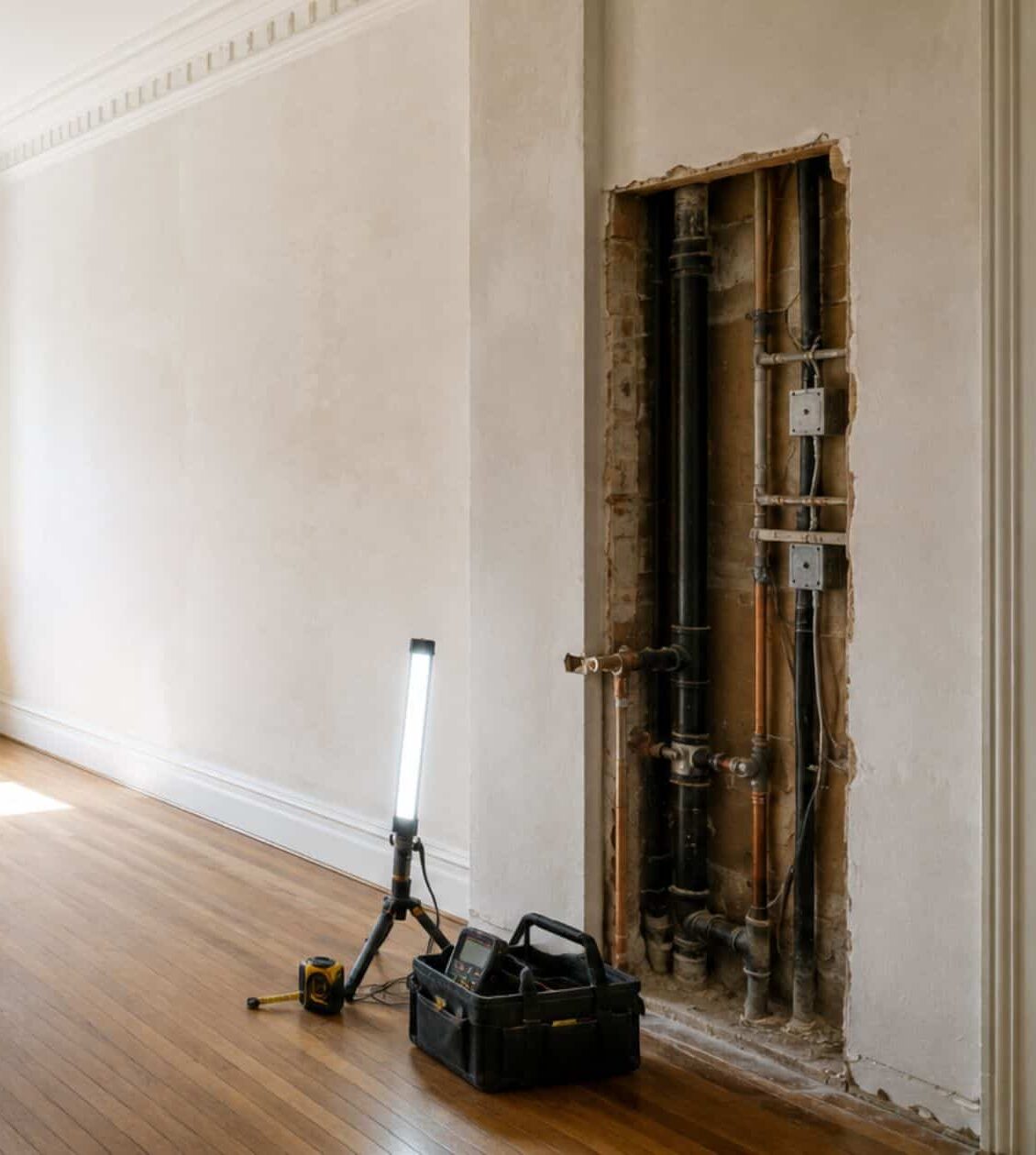
This is where most burned homeowners lost money. The contractor encountered something unexpected — common in pre-war Manhattan buildings with aging plumbing or Brooklyn brownstones with century-old infrastructure — did the work, and presented a bill. You never agreed.
A legitimate change-order process protects you from this pattern:
- Stop. When something outside the original scope arises, work on that item pauses.
- Show. The contractor brings you to the site (or sends photos) to see the issue.
- Price. You receive a written cost for the additional work before it begins.
- Sign. You approve the change order in writing.
- Proceed. Only after approval does the work happen.
This sequence — what we call “transparent upfront” — ensures you’re never surprised by charges for work you didn’t authorize.
How to Spot a Red-Flag Bid
Bid opacity often predicts change-order problems. If a proposal doesn’t itemize general conditions (site management, project management, labor) and overhead separately, those costs are hidden in materials and labor line items. When the hidden costs exceed reality, change orders follow.
Vague “allowances” are another warning sign. An allowance of “$5,000 for fixtures” sounds reasonable until you learn that the fixtures you actually want cost $12,000 — and the difference becomes a change order.
Your Building Is Part of the Accountability Equation
Short answer: In NYC co-ops and condos, accountability extends beyond the contractor-homeowner relationship. A contractor who can’t manage your building’s approval process, insurance requirements, and work rules will fail regardless of how well they communicate with you.
If you’re renovating in a co-op or condo — which covers most Manhattan and Brooklyn apartments — there’s an accountability layer the burned-buyer conversation often misses: your building.
NYC buildings have their own requirements that go far beyond “licensed and insured.” Co-op and condo boards typically require liability insurance ranging from $1 million to $10 million or more, depending on the building’s rules — requirements spelled out in your alteration agreement and enforced by the managing agent.[^1] Add summer work rules, elevator reservation schedules, and noise restrictions that vary building by building, and you begin to see the complexity.
Why “Licensed and Insured” Isn’t Enough in a Co-op or Condo
“Licensed and insured” is a minimum entry requirement for any contractor. NYC requires home improvement contractors to be licensed through the Department of Consumer and Worker Protection, but that license doesn’t address your building’s specific requirements.[^2]
Whether you’re in a full-service Upper East Side co-op or a smaller Brooklyn condo, your board evaluates contractors based on insurance limits, prior experience in similar buildings, and references from supers and managing agents.
The Track Record Question Most Homeowners Forget to Ask
Here’s a question that separates experienced NYC renovation firms from the rest: “Have you ever been rejected by a building?”
A firm with deep NYC experience should have a track record of successful building approvals across different co-ops and condos — from pre-war buildings on the Upper West Side to newer construction in Tribeca. If they hesitate or can’t provide building-specific references, their accountability may end at your apartment door.

What 25 Years of NYC Renovations Teaches About Accountability
Short answer: Longevity in NYC’s renovation market requires earning trust project after project. Firms that don’t deliver on accountability don’t survive — and repeat customers are the clearest proof that a firm’s accountability is real.
At MyHome, we’ve spent 25 years learning what accountability means in practice — not as a marketing promise, but as the daily behaviors that keep projects on track and homeowners informed.
That longevity isn’t an accident. NYC renovation is a referral-driven business. Firms that ghost clients, surprise them with charges, or leave them wondering who’s responsible don’t get second chances. They certainly don’t get third, fourth, or fifth projects from the same families — which we do, regularly.
The Three People You’ll Know by Name
When you work with MyHome, you’ll know exactly who’s responsible for your project at every stage. Your Renovation Expert handles your initial consultation and proposal. Your Designer guides material and fixture selections at our Midtown showroom, where you can see and touch thousands of samples. Your Project Manager leads from the construction kickoff through completion, including weekly written reports and on-site coordination.
This isn’t a rotating cast. It’s a defined relay with intentional handoffs.
Weekly Reports, a Written Warranty, and a Change-Order Policy You Can Hold Us To
Accountability at MyHome includes:
- Weekly written progress reports with photos, milestones, and any decisions you need to make
- A 10-year written warranty that backs our workmanship — not a handshake, a document you can reference
- A “transparent upfront” change-order policy: we price likely extras in your proposal before you sign, and any mid-project changes follow the stop-show-price-sign-proceed sequence
We’ve never been turned down by a residential building in 25 years of NYC renovations — from landmark brownstones in Greenwich Village to high-rises in Hell’s Kitchen. That track record reflects the same accountability we bring to every phase of your project.
You can see how our process works at our remodeling process page and review what past clients say about working with our team.
Frequently Asked Questions
How do I know if a contractor is actually accountable before I hire them?
Ask for the names of who you’ll work with, their communication cadence (do they send written weekly updates?), and their change-order policy. Vague answers signal vague accountability.
What should I look for in a contractor after a bad experience?
Named contacts with defined roles, proactive written updates on a set schedule, a sign-before-charge change-order process, and a written warranty — not verbal promises.
Is “licensed and insured” enough to trust a contractor in NYC?
It’s a minimum. NYC buildings often require $2M–$10M in insurance, plus board approval through an alteration agreement. Licensed and insured doesn’t mean your building will say yes.
How do I check a contractor’s track record with NYC buildings?
Ask if they’ve ever been rejected by a co-op or condo board. Ask for references from building supers or managing agents — not just homeowners.
Ready to Work with an Accountable Team?
Burned by a bad contractor? Book a free consultation with a reliable team. You’ll meet your Renovation Expert, see our process, and get an itemized proposal — with no obligation and no pressure.
After 25 years of NYC renovations across Manhattan and Brooklyn, we know that accountability isn’t a promise. It’s a practice. Let us show you what that looks like.
Call us at 212.666.2888 or schedule your free consultation online.
Sources
[^1]: The Cooperator. Co-op and condo alteration agreement requirements, including insurance minimums and board approval processes. https://www.cooperatornews.com/
[^2]: NYC Department of Consumer and Worker Protection. Home Improvement Contractor License Requirements. https://www.nyc.gov/site/dca/businesses/license-checklist-home-improvement-contractor.page

Yoel Piotraut
Yoel Piotraut is the Founder of MyHome Renovation Experts, a New York City renovation company that has completed complete-apartment, kitchen, and bathroom renovations across Manhattan and Brooklyn for 25 years. He works closely with co-op and condo owners on building approvals, alteration agreements, and the realities of renovating occupied NYC apartments. Connect with Yoel on LinkedIn: https://www.linkedin.com/in/yoelpiotraut/
Related Posts

How to Choose a Renovation Company for Your NYC Co-op: The 8 Questions That Separate Great Contractors from Expensive Mistakes
Learn how to choose a co-op renovation company in NYC. 8 critical questions covering board...

What Your Contractor Should Handle So Your Co-op or Condo Board Approves Your NYC Renovation
Learn what your NYC renovation contractor should handle—alteration agreements, insurance, board liaison—so your co-op or...
What NYC Co-op Renovations Actually Cost—And How to Avoid Budget Surprises
Learn what NYC co-op renovations cost in 2025. Get real price ranges for kitchens, bathrooms,...