Home Planning & Renovations
How to Choose a Co-op Renovation Company in NYC: 8 Questions to Ask Before You Sign
By Yoel Piotraut
Choosing a co-op renovation company NYC homeowners can actually trust is harder than it should be. Every contractor’s website says they “handle everything” and “make it easy.” But co-op renovations in Manhattan and Brooklyn fail for reasons that have nothing to do with tile choices or cabinet finishes — they fail because the company didn’t understand the building, couldn’t get board approval, or disappeared when problems surfaced.
This guide gives you the questions that separate contractors who’ve actually done this from those who are learning on your project. Ask these before you sign anything.
At a glance
- Ask about tenure and track record — years in NYC co-ops and a history of board approvals reveal whether a company has done this successfully or is learning on your project.
- Understand who you’ll communicate with — the best firms assign named contacts for consultation, design, and construction, with weekly written updates so you’re never chasing anyone.
- Clarify permits, change orders, and proposals — full-service means they handle DOB filings, pre-price likely surprises, and itemize every cost before you sign.
- Demand a written warranty and co-op references — verbal promises mean nothing, and townhouse references don’t prove board-approval competence.
- Choose design-build for co-ops — single accountability reduces approval risk and eliminates finger-pointing between separate architects and contractors.


Why Choosing a Co-op Renovation Company Is Different in NYC
Short answer: Co-op and condo renovations require board approval, Alteration Agreements, specific insurance documentation, and DOB permits — layers of complexity that don’t exist in single-family homes or most markets outside New York City.
A contractor who’s excellent at suburban single-family renovations may have never submitted an Alteration Agreement. A company that does beautiful work in new-construction condos may not know how to handle the plumbing risers, plaster walls, and electrical limitations of a pre-war Upper West Side co-op.
The building is a character in your renovation story. Your board reviews and approves every project. Your managing agent coordinates insurance certificates and work schedules. Your super controls elevator access and monitors hallway protection. The right contractor knows how to work within this system — not fight against it.
What a Co-op Board Requires That Other Projects Don’t
Before construction starts, most co-op boards require:
- A signed Alteration Agreement outlining exactly what work will be done
- Proof that your contractor carries insurance matching the building’s requirements
- Licensed contractor documentation for every trade entering the building
- Architect or engineer-stamped drawings for any work requiring DOB permits¹
- Engineering letters for structural, plumbing, or mechanical changes in some buildings
Condos typically have lighter requirements, but still require board notification, insurance compliance, and adherence to house rules for working hours, elevator use, and common-area protection.
The point: your contractor needs to produce a complete, compliant package that the board will approve. If they can’t, your project stalls before a single wall comes down.
The 8 Questions to Ask Any Co-op Renovation Company NYC Homeowners Should Know
Short answer: Ask about tenure, board-approval track record, communication structure, permit handling, change-order policy, proposal transparency, warranty terms, and co-op-specific references. The answers reveal whether a company has done this successfully — or is claiming they can.
1. How Long Have You Been Renovating NYC Co-ops and Condos?
Years in the city matter. Relationships with building managers on the Upper East Side, familiarity with DOB processes, knowledge of what different boards expect from Chelsea to Brooklyn Heights — all of it compounds over time. A company that’s been doing this for decades has seen every building quirk, every approval wrinkle, every pre-war surprise.
What to listen for: a specific number of years, not vague “extensive experience.” Ask follow-up questions about which neighborhoods they work in and whether they’ve renovated in your building or similar buildings.
2. What’s Your Track Record With Board Approvals?
This is the question that matters most. Ask directly: have you ever had a board reject your package? How do you handle buildings you haven’t worked in before?
A strong answer sounds like: “We’ve never been turned down by a residential building. We prepare complete packages and work with management companies proactively.” A weak answer sounds like: “We’ll figure it out” or “that’s usually not a problem.”
Ask for references from similar buildings — not just happy clients, but clients whose boards approved the work.
3. Who Will I Actually Communicate With — And How Often?
The most common complaint in renovation reviews isn’t bad tile work. It’s an absent project manager, unreturned calls, and the feeling of being left in the dark.
Ask for names and roles. The best firms have a clear structure: who handles your initial consultation, who guides design, who manages construction, and how handoffs work between them. You should know exactly who to call at every stage.
Ask about update frequency too. Weekly written reports are better than “call us anytime.” A defined communication cadence means you’re not chasing anyone for information.
4. Do You Handle DOB Permits and Inspections, or Do I?
Some contractors expect you to hire an architect separately, coordinate your own expediter, or manage DOB filings yourself. That’s not full-service — that’s shifting the hardest parts of a NYC renovation onto you.
A true design-build firm manages permit applications, coordinates inspections, and handles sign-offs through the NYC Department of Buildings² filing system. Ask who pulls the permits, whose name is on them, and who’s responsible if there’s a DOB issue.
The answer you want: “We handle all of it. You never have to deal with the city.”
5. How Do You Handle Change Orders and Surprises?
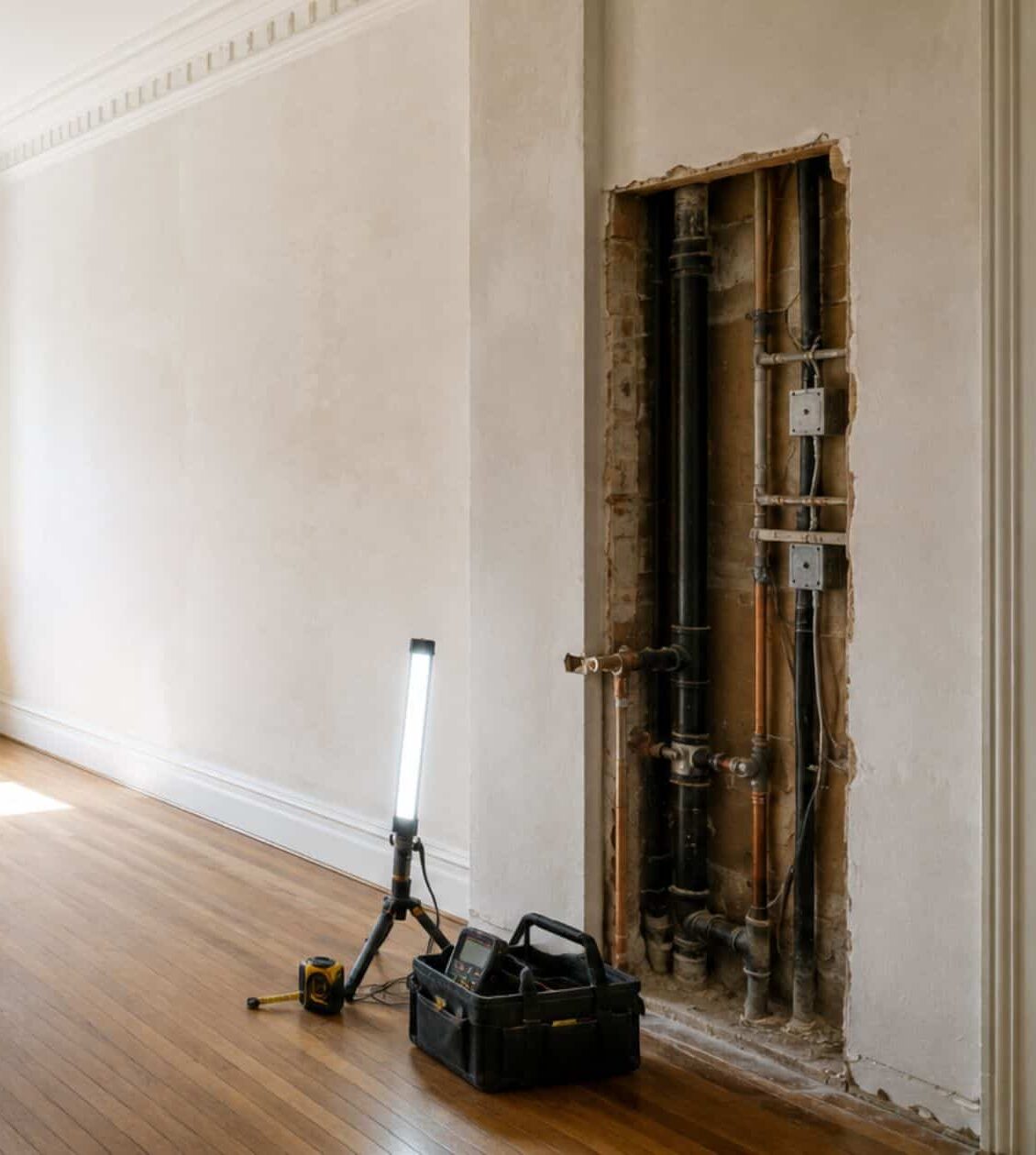
Pre-war buildings across the Upper West Side, Greenwich Village, and brownstone Brooklyn hide things: old galvanized plumbing, asbestos in floor mastic, electrical panels that need upgrading, subfloors that aren’t level. In buildings constructed before 1978, lead paint may also be present and requires safe work practices under EPA regulations³. The question isn’t whether you’ll encounter surprises — it’s how they’re handled when you do.
Red flag: “We’ll deal with it as it comes up.”
Green flag: A defined protocol. The best companies stop work, bring you to see the issue, explain what’s needed and what it costs, get your written approval, and only then proceed.
Ask whether the proposal pre-prices likely surprises — permit fees, riser tie-ins, subfloor corrections, asbestos testing. A company that’s done hundreds of co-op renovations knows what usually comes up and can include allowances upfront.

6. What’s Included in Your Proposal — And What Isn’t?
Ask to see a sample proposal format. Is it itemized or a single lump sum? Does it break out labor, materials, permits, and contingencies? Can you see exactly what you’re paying for?
Specifically ask about common extras that surprise homeowners:
- Permit and filing fees
- Riser and branch-line plumbing work
- Electrical panel upgrades
- Subfloor corrections and acoustic underlayment
- Asbestos and lead testing
- Con Edison coordination for gas work
The proposal should make clear what’s included and what could be additional. If they can’t answer clearly before you sign, that’s your answer.
7. Do You Carry a Written Warranty — And What Does It Cover?
Verbal promises disappear when there’s a problem. Ask for the warranty document and read it before signing anything.
Key questions:
- How many years does the warranty cover?
- Does it cover labor, materials, or both?
- What’s the process for making a claim?
A company confident in their craftsmanship will have clear, written terms. A company that hesitates or offers vague assurances is telling you something.
8. Can I Talk to Past Clients Who Renovated in a Co-op or Condo?
References matter, but co-op-specific references matter more. A glowing review from a Brooklyn townhouse client doesn’t prove the company can navigate a pre-war Upper East Side co-op board.
Ask for 2-3 references from similar projects: co-op versus condo, pre-war versus post-war, Manhattan versus Brooklyn. Ask those references the same questions you’d ask the company — and listen for consistency.
What “Design-Build” Means for Co-op Renovations — And Why It Matters
Short answer: Design-build means one company handles both design and construction under single accountability. For co-ops, this reduces approval risk because the Alteration Agreement package requires coordinated drawings that match what’s actually being built.
Design-Build vs. Hiring an Architect and Contractor Separately
Hiring separately gives you more control over each relationship — but it also means you’re the project manager. When the architect’s drawings don’t match what the contractor priced, or when the board asks a question and no one knows whose job it is to answer, you’re the one making calls and chasing people.
Design-build puts one company in charge of both. The drawings, the budget, the board package, and the construction all align because the same team is responsible for all of it. If something doesn’t work, there’s no finger-pointing — there’s one accountable team.
For co-op renovations, design-build typically wins on timeline and approval simplicity. The board sees a complete, coordinated package from a single source. Changes during design don’t require renegotiating with a separate contractor. And when surprises surface during construction, the people who designed the project are the same people solving the problem.

Red Flags That Should Make You Walk Away
Trust your instincts, but also watch for these warning signs:
- No physical NYC address. If they can’t tell you where their office or showroom is located in Manhattan or Brooklyn, keep looking.
- Can’t name specific buildings they’ve worked in. Vague answers about “lots of co-ops” without specifics suggest limited experience.
- Won’t provide a written proposal before you sign a contract. You should see itemized costs before committing to anything.
- Asks for a large upfront deposit. NYC regulations through the Department of Consumer and Worker Protection⁴ govern home improvement contracts.
- Dismisses board-approval complexity. If they treat the Alteration Agreement as a minor detail, they haven’t done many co-op projects.
- No warranty or vague warranty. A company that won’t put their guarantee in writing doesn’t have one.
How MyHome Answers These 8 Questions
We built this guide because we believe homeowners should know what to ask — even if they end up choosing someone else. Here’s how we answer our own questions:
Years in NYC co-ops and condos: 25 years renovating apartments across Manhattan and Brooklyn — from pre-war classics on the Upper West Side to modern condos in Tribeca and co-ops throughout Brooklyn.
Board-approval track record: We’ve never been turned down by a residential building. We manage both your building’s approval process and all DOB filings — you never deal with either.
Who you’ll communicate with: Three named people across your project: your Renovation Expert handles the initial consultation and proposal, your Designer guides material and layout decisions at our Midtown showroom, and your Project Manager leads construction from kickoff through completion. Weekly written reports keep you informed without you having to ask.
Permits and inspections: We handle all DOB filings, coordinate with architects who pull permits, and manage every inspection through sign-off.
Change orders: We price likely surprises upfront in your proposal — permit fees, potential riser work, subfloor corrections. When something unexpected surfaces, we stop, show you, explain the cost, and get your written approval before proceeding.
Proposal transparency: Every proposal itemizes labor costs. You see exactly what you’re paying for before you sign.
Warranty: We provide a 10-year written warranty. See our warranty terms.
References: We’re happy to connect you with past clients who renovated in co-ops and condos similar to yours. Read what they say.
Frequently Asked Questions
How long does a co-op renovation take from start to finish?
Board approval typically takes 30–60 days for complete packages. Construction duration depends on scope — full gut renovations often run 4–6 months after approval. Pre-war conditions and building work-hour restrictions can extend timelines.
What’s the difference between renovating a co-op and a condo in NYC?
Co-ops typically have stricter board oversight and require formal Alteration Agreements. Condos often have lighter approval processes but still require board notification, insurance documentation, and compliance with house rules.
Can I live in my apartment during a co-op renovation?
For single-room renovations with proper dust control and site protection, yes. For gut renovations affecting kitchens, bathrooms, and multiple rooms, most homeowners relocate temporarily. We protect floors, walls, and common areas so living in during smaller projects is manageable.
Do I need an architect for a co-op renovation in NYC?
For work requiring DOB permits — structural changes, plumbing relocation, electrical upgrades, gas work — architect or engineer-stamped drawings are required by the NYC Department of Buildings¹. Design-build firms coordinate this so you don’t hire separately. Learn more about our renovation process.
Comparing NYC renovation companies for your co-op or condo? Book a free consultation with a Renovation Expert. We’ll walk through your project, your building’s requirements, and answer every question on this list — so you can hire with confidence. See completed projects across Manhattan and Brooklyn.
Sources
- NYC Department of Buildings — Alterations and Renovations: https://www.nyc.gov/site/buildings/homeowner/alterations-renovations.page
- NYC Department of Buildings — Homepage: https://www.nyc.gov/site/buildings/index.page
- U.S. Environmental Protection Agency — Renovation, Repair, and Painting Program (RRP Rule): https://www.epa.gov/lead/renovation-repair-and-painting-program
- NYC Department of Consumer and Worker Protection — Home Improvement Contractor License: https://www.nyc.gov/site/dca/businesses/license-checklist-home-improvement-contractor.page

Yoel Piotraut
Yoel Piotraut is the Founder of MyHome Renovation Experts, a New York City renovation company that has completed complete-apartment, kitchen, and bathroom renovations across Manhattan and Brooklyn for 25 years. He works closely with co-op and condo owners on building approvals, alteration agreements, and the realities of renovating occupied NYC apartments. Connect with Yoel on LinkedIn: https://www.linkedin.com/in/yoelpiotraut/
Related Posts

How to Choose a Renovation Company for Your NYC Co-op: The 8 Questions That Separate Great Contractors from Expensive Mistakes
Learn how to choose a co-op renovation company in NYC. 8 critical questions covering board...

What Your Contractor Should Handle So Your Co-op or Condo Board Approves Your NYC Renovation
Learn what your NYC renovation contractor should handle—alteration agreements, insurance, board liaison—so your co-op or...
What NYC Co-op Renovations Actually Cost—And How to Avoid Budget Surprises
Learn what NYC co-op renovations cost in 2025. Get real price ranges for kitchens, bathrooms,...