Home Planning & Renovations
9 Questions to Ask Before Hiring a NYC Renovation Contractor
By Yoel Piotraut
Choosing a NYC renovation contractor is one of the most consequential decisions you’ll make as a homeowner — and one of the hardest to get right. Six-figure budgets. Months of disruption. A home you’ll live in for years. Generic advice about checking references and getting multiple bids barely scratches the surface.
NYC apartment renovation is a different game. You’re not just hiring someone to swing a hammer. You need a team that can navigate your co-op or condo board, coordinate with the Department of Buildings, respect your building’s rules, and keep you informed without making project management your second job. Whether you’re in a pre-war co-op on the Upper West Side or planning a Brooklyn kitchen renovation in a modern condo, the complexity is real — and the wrong contractor will make it worse.
These nine questions will help you separate contractors who understand NYC from those who don’t.
At a glance
- Verify building-specific experience — a contractor who has worked in your building or similar ones already knows the board, the super, and the rules
- Confirm who handles approvals — the right contractor manages both your building’s alteration agreement and all DOB filings so you don’t coordinate between them
- Demand clear communication structure — know exactly who you’ll talk to at each phase and how often you’ll receive written updates
- Understand the change-order protocol — the best contractors price likely surprises upfront and follow a stop-show-price-sign-proceed process for true unknowns
- Get the warranty in writing — a longer written warranty signals confidence in the work and business stability to stand behind it

Question 1: Have You Worked in My Building or a Similar One?
Short answer: A contractor with experience in your building — or buildings like it — already knows the board, the super, and the rules. That translates to fewer surprises and faster approvals.
NYC buildings aren’t interchangeable. A 1920s co-op on the Upper East Side operates differently than a postwar condo in Chelsea or a brownstone in Park Slope. Each has its own alteration agreement requirements, insurance thresholds, working-hour restrictions, and relationships with building management.
When a contractor has worked in your building before, they’ve already passed the board’s trust screen. They know which super to coordinate with, which freight elevator rules matter, and what documentation the managing agent expects. That history eliminates friction.
If they haven’t worked in your building specifically, ask about similar buildings: same board structure, same era, same neighborhood. A contractor who has successfully completed dozens of co-op renovations across Manhattan and Brooklyn understands the process even if your specific address is new to them.
What to listen for: Specific building names, an offer to check whether they’ve worked in yours, and unprompted mentions of board-approval experience. Be wary of vague answers like “we work all over the city” with no specifics.

Question 2: Who Handles My Building’s Approval Process?
Short answer: The right contractor manages both your building’s approval (the alteration agreement) and the city’s permits (DOB filings) — so you don’t have to coordinate between them.
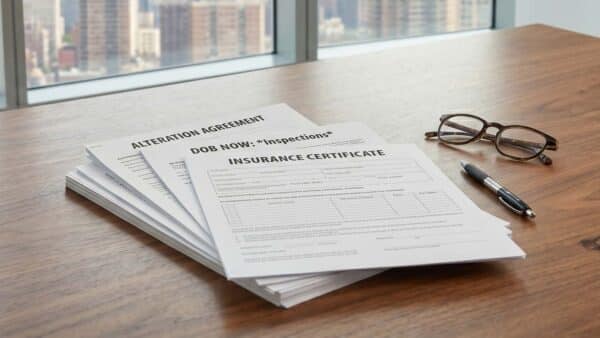
Most NYC co-ops and condos require an alteration agreement before any renovation work begins. This process is governed by your building’s proprietary lease or bylaws, with oversight from the NY Attorney General’s Real Estate Finance Bureau for co-op and condo governance matters.¹ The alteration agreement isn’t a city permit — it’s your building’s internal approval process. You’ll need to submit contractor credentials, insurance certificates, architectural plans, and sometimes neighbor consent forms.
Separately, the Department of Buildings requires permits for most renovation work involving structural changes, plumbing, electrical, or gas.² These involve filings through the DOB NOW system, inspections, and sign-offs that happen on the city’s timeline.³
A contractor who handles both tracks removes the most tedious and time-consuming parts of the process from your plate. Ask directly: “Do you prepare and submit the alteration agreement package, or is that my responsibility?”
The “never been rejected” benchmark: A contractor with a strong board-approval track record signals they understand what buildings require. Boards don’t approve contractors who cause problems, damage common areas, or ignore building rules. MyHome has never been turned down by a residential co-op or condo building — and that track record matters when your board is deciding whether to approve your project.
Who handled the paperwork on recent MyHome jobs
Full apartment remodel at 410 West 24th Street, Midtown West: before any work began, the contractor filed insurance certificates with the Department of Buildings, obtained the permits and paid the fees, in a building of roughly 702 apartments that stayed occupied throughout. Plumbing and electrical were done by separately licensed trades with their own permits, inspections and sign-offs.
Tub-to-shower bathroom at 201 East 17th Street, Gramercy: the building’s engineer reviewed the scope three times between April and June 2022. The first review, 29 numbered conditions, was answered on 12 May point by point in the same format, with a commitment to pull an LAA permit for the new shower scope.


Question 3: Who Will Be My Main Point of Contact?
Short answer: You should know exactly who you’ll talk to at each project phase — and how to reach them. Vague answers about “the team” are a red flag.
The most common complaint in contractor horror stories isn’t bad tile work or missed deadlines. It’s “I couldn’t get anyone on the phone.” Communication breakdowns create anxiety, erode trust, and turn manageable problems into relationship-ending disputes.
Before you sign anything, ask: Who will I talk to during design? Who takes over during construction? How do I reach them? How often will I get updates?
The best contractors use a clear handoff structure. At MyHome, you work with a Renovation Expert during the initial assessment, transition to a Designer for materials and layout, then have a dedicated Project Manager lead the build. Three people, in sequence, each accountable for their phase — not a rotating cast of whoever happens to be available.
The named-team test: A contractor who can name specific people demonstrates accountability. Ask if you’ll receive written updates — weekly reports with photos and progress summaries are standard practice for serious firms. If the answer is “we’ll be in touch when there’s news,” keep looking.
How to Find the Right NYC Renovation Contractor: Pricing and Process
Question 4: How Do You Handle Change Orders?
Short answer: The best contractors tell you what could change — and approximately what it would cost — before you sign. Then they follow a clear protocol: stop, show you the issue, price it, get your sign-off, proceed.
Change orders are the #1 source of budget disputes in renovation. Something unexpected appears behind a wall — old plumbing, damaged subflooring, electrical that doesn’t meet code — and suddenly you’re facing an unplanned expense with no time to think.
A trustworthy contractor addresses this upfront. In their initial proposal, they should identify likely surprises (riser/pipe work, subflooring conditions, permit fees) and give you a realistic range for what those could cost. This doesn’t eliminate uncertainty, but it prepares you for it.
Then ask about their mid-project protocol: “If you find something unexpected, what happens next?” The gold standard is stop → show → price → sign → proceed. They pause work, bring you to see the issue, explain exactly what it will cost to address, get your written approval, and only then move forward.
MyHome calls this approach “transparent upfront.” Likely extras are priced in your proposal before you sign. True surprises follow the protocol — you see it, you approve it, then we proceed. Never “replace first, bill later.”
Red flag: “We’ll handle it and settle up at the end.” That’s how budgets spiral out of control.

Question 5: Can I See an Itemized Proposal Before I Commit?
Short answer: An itemized proposal shows you exactly where your money goes — labor separated from materials, line by line. It’s the only way to compare bids accurately.
A lump-sum bid tells you the total. An itemized proposal tells you the story: how much for demolition, how much for plumbing labor, how much for electrical, how much for tile installation. When you can see the components, you can make informed trade-offs.
Ask specifically: “Do you separate labor costs from materials costs?” This matters because labor to install a $500 refrigerator and an $8,000 Sub-Zero is roughly the same. When labor and materials are bundled, you can’t tell whether you’re paying for better quality or just a hidden markup.
Every project at MyHome starts with an itemized labor proposal delivered before you commit. You see the numbers, ask questions, and decide with full information.
Question 6: What’s Your Warranty, and What Does It Cover?
Short answer: Get the warranty in writing. Clarify whether it covers labor, materials, or both — and for how long. A longer warranty signals confidence in the work.
Many contractors offer a one-year warranty or no written warranty at all. That’s a problem when a tile starts coming loose in year two or a cabinet hinge fails in year three.
Ask for specifics: What exactly is covered? What’s the process for making a claim? A contractor who can hand you a written warranty document — not just verbal assurance — is one who expects their work to hold up and has the business stability to stand behind it.
MyHome extends a 10-year written warranty on labor. That’s not an industry standard — it’s a deliberate choice to demonstrate confidence in the quality of the work.
What MyHome proposals and change orders looked like
Galley kitchen at 25 Indian Road, Inwood: the specification named every item with a manufacturer, model number, finish, dimensions and who was supplying it, client or MyHome. The old kitchen had no backsplash tile and no over-the-range microwave, so both were priced as additions from the start.
Full apartment renovation at 160 West 66th Street, Upper West Side: the job had two change orders, on 25 April and 7 May 2024, and both were finish swaps rather than surprise costs: part of the switch and outlet package changed color, a towel bar was added and seven more recessed fixtures went in.
Question 7: How Long Have You Been Doing This in NYC?
Short answer: Tenure matters because NYC renovation is a relationship business. A contractor with decades of experience has built relationships with buildings, supers, suppliers, and city agencies.
Ask for years, not project counts. “Thousands of projects” is hard to verify. “25 years in business” is not.
MyHome has been renovating NYC apartments since 2001 — working across the Upper East Side, Upper West Side, Chelsea, Hell’s Kitchen, Tribeca, Greenwich Village, Soho, Flatiron, and Brooklyn.
Question 8: Can I Visit Your Showroom or a Completed Project?

Short answer: A Manhattan showroom where you can see and touch materials signals operational depth. A willingness to show completed work demonstrates confidence.
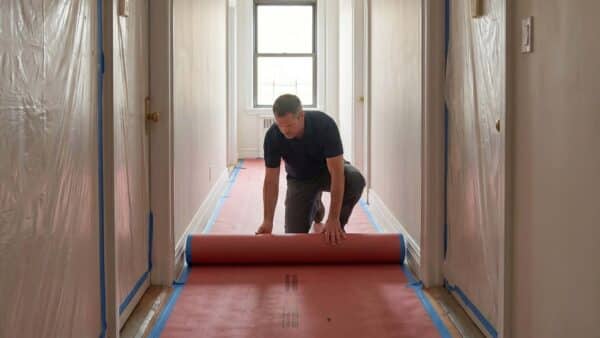
When you visit a showroom, you can evaluate cabinets, countertops, tile, and fixtures in person — making design decisions easier and faster. When you visit a job site, notice the cleanliness, the protection on floors and walls, and how the crew interacts. These details predict how they’ll treat your home.
MyHome’s Midtown showroom features model kitchens and bathrooms with thousands of samples. Walk through, touch materials, and work with a designer to see what’s possible — before you commit to anything.
Question 9: Can I Live in My Apartment During the Renovation?
Short answer: Many NYC homeowners must stay in their apartment during the work. Ask how the contractor manages dust, debris, access, and building common areas.
The building super test: Ask if building supers have complimented their crews. A contractor who leaves hallways spotless and respects freight-elevator schedules is one the building will welcome back — and one who won’t create problems with your neighbors.
At MyHome, we protect your floors, walls, and building hallways throughout the project. Our crews clean up daily. It’s one reason building supers keep approving our projects.
How to Use These Questions
Print this list. Bring it to every contractor meeting. Ask each question and write down the answers. Then compare.
The contractor who answers with specifics, names, and documented proof — not vague reassurances — is the one most likely to deliver.
Red flags that should end the conversation:
- Refuses to provide a written warranty
- Can’t name who you’ll talk to during the project
- Never mentions the board-approval process
- Won’t provide an itemized proposal
- Demands a large upfront deposit before starting
- Badmouths other contractors instead of explaining their own process
You can verify that any contractor holds a valid NYC Home Improvement Contractor license through the Department of Consumer and Worker Protection.⁴
Bring These Questions to Your Free Consultation
Test MyHome against this list. In your consultation, a Renovation Expert will visit your home, assess the scope, and answer every question on this page — with specifics, not sales talk.
After the visit, you’ll receive an organized recap and a written proposal outlining the recommended scope of work and pricing. No pressure, no vague estimates, no wondering what happens next.
MyHome has spent 25 years helping Manhattan and Brooklyn homeowners navigate renovations — from board approvals and DOB filings to design, construction, and final walkthrough. We’ve worked in hundreds of buildings across the Upper East Side, Upper West Side, Chelsea, Hell’s Kitchen, Tribeca, Greenwich Village, Soho, Flatiron, and Brooklyn. We’ve never been turned down by a residential co-op or condo board.
Meet your Renovation Expert — book a free consultation.
Sources
- New York State Attorney General — Real Estate Finance Bureau (co-op and condo governance): https://ag.ny.gov/real-estate-finance
- NYC Department of Buildings — Alterations and Renovations (homeowner permit guidance): https://www.nyc.gov/site/buildings/homeowner/alterations-renovations.page
- NYC Department of Buildings — DOB NOW (online filing system): https://www.nyc.gov/site/buildings/industry/dob-now.page
- NYC Department of Consumer and Worker Protection — Home Improvement Contractor License: https://www.nyc.gov/site/dca/businesses/license-checklist-home-improvement-contractor.page

About the Author
Yoel Piotraut is the Founder of MyHome Renovation Experts, a New York City renovation company that has completed complete-apartment, kitchen, and bathroom renovations across Manhattan and Brooklyn for 25 years. He works closely with co-op and condo owners on building approvals, alteration agreements, and the realities of renovating occupied NYC apartments.

Yoel Piotraut
Yoel Piotraut is the Founder of MyHome Renovation Experts, a New York City renovation company that has completed complete-apartment, kitchen, and bathroom renovations across Manhattan and Brooklyn for 25 years. He works closely with co-op and condo owners on building approvals, alteration agreements, and the realities of renovating occupied NYC apartments. Connect with Yoel on LinkedIn: https://www.linkedin.com/in/yoelpiotraut/
Related Posts

How to Shortlist Full-Service Firms for a Brooklyn Heights Co-op Renovation Before You Request Quotes
A pre-quote screening method for Brooklyn Heights co-op owners: evaluate renovation firms for relevant experience,...

Who Handles an NYC Apartment Renovation From Design Through Board Approval and Construction?
See what an end-to-end NYC apartment renovation partner should handle—from design and board packages to...

What Happens at a Designer-Guided NYC Renovation Showroom Appointment?
Overwhelmed by tile, stone, cabinets, and fixtures? Learn what to bring to a designer-guided NYC...