Home Planning & Renovations
What “Full-Service” Actually Means in NYC Design-Build — And How to Know Your Renovation Firm Will Deliver
By Ofek Dahan
NYC design-build accountability separates renovation firms that deliver from firms that simply promise. Every design-build company in New York claims to offer “one team,” “single-point responsibility,” and “peace of mind.” But when you ask what happens when they open your walls and find knob-and-tube wiring, most can’t give you a straight answer.
This post explains what accountability actually looks like in a full-service NYC renovation — the specific systems that protect your budget, your timeline, and your sanity.
At a glance
- Ask about change-order protocols — a documented process protects you from surprise costs appearing on your invoice without approval.
- Know your communication structure — you should have named contacts for design and construction before you sign anything.
- Compare warranty terms in writing — industry standard is one to three years, so longer coverage is a meaningful differentiator.
- Confirm building approval track record — ask how many co-op or condo boards have rejected the firm’s packages.
- Demand systems, not promises — “full-service” means nothing without documented protocols you can verify.
What “Full-Service Design-Build” Actually Promises — And What It Leaves Undefined
The short answer: Design-build means one firm handles both design and construction. That’s the easy part. The hard part is understanding what happens when plans change, costs shift, or problems emerge mid-project.
Every design-build firm in NYC will tell you they offer a “seamless experience” with “one team managing everything.” On paper, design-build does solve real problems. You don’t hire an architect, then a designer, then a general contractor. You don’t manage three contracts and three schedules. You don’t referee when someone blames someone else for a delay.
But “full-service” is not a regulated term. Any firm can claim it. The question isn’t whether they offer design and construction under one roof — it’s whether they have documented systems for the moments when things don’t go according to plan.
The Marketing Version vs. the Operational Version
The marketing version of design-build sounds like this: “We handle everything so you don’t have to worry.”
The operational version requires answers to harder questions:
- Who do you call on day 47 of construction when you have a concern?
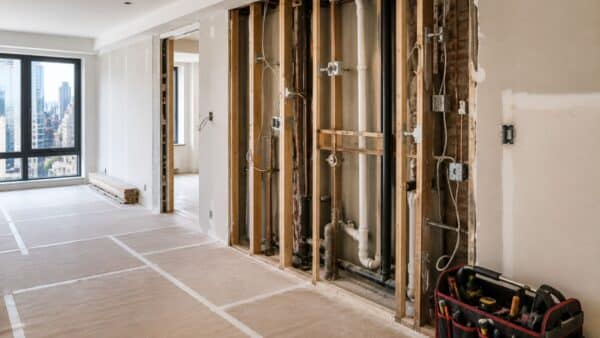
- What happens when demolition reveals water damage that wasn’t visible before?
- How are unexpected costs communicated, approved, and documented?
- What does your warranty actually cover, and for how long?
These aren’t hypothetical problems. In NYC renovations — especially in co-ops and condos — surprises are the rule, not the exception. Pre-war buildings hide decades of previous work. Risers and pipes serve multiple units. Subflooring conditions can’t be confirmed until floors come up.
A truly accountable design-build firm has written protocols for these moments. A firm running on promises does not.


The Three Systems Behind NYC Design-Build Accountability
The short answer: Before signing with any firm, ask about their change-order protocol, their communication structure, and their warranty terms. These three systems reveal whether “full-service” means anything.
Change-Order Protocol — What Happens When They Find Something Unexpected
The number one fear NYC homeowners have about renovation isn’t the dust or the timeline. It’s the phone call that says: “We found something. It’s going to cost more.”
How a firm handles that moment tells you everything about their accountability.
The wrong way: Contractor finds the problem, fixes it, sends you a bill. You had no say, no approval, and no chance to evaluate alternatives. This is how budgets spiral.
The accountable way: Work stops. The contractor brings you to the site or sends photos. They explain exactly what they found, why it matters, and what the fix costs. You review and sign a change order before any additional work begins. Nothing gets replaced first and billed later.
At MyHome, we price likely extras — permit fees, riser work, subflooring conditions — directly in the proposal upfront. When something truly unexpected appears mid-project, our protocol is simple: stop, show you, explain the reason and exact price, get your written approval, then proceed.
Ask any design-build firm to explain their change-order protocol in writing before you sign.
Communication Structure — Who You Actually Talk To (And When)
“You’ll have a dedicated team” means nothing if you don’t know who that team is.
In a full-service design-build renovation, you should know — before signing — exactly who your primary contact is during design, who takes over during construction, and how handoffs work.
At MyHome, you work with three people in sequence:
- Renovation Expert — Your first contact. Handles your initial consultation, walks your space, and develops your proposal.
- Designer — Takes over once you sign. Leads material selection, layout planning, and design development.
- Project Manager — Enters at your kickoff meeting and leads from there. Your primary contact through construction and closeout.
This is a deliberate relay where each person has a defined role and a defined handoff. Weekly written reports keep you informed throughout construction — you should never have to wonder what’s happening in your apartment.
Ask any design-build firm: “Who will I talk to during design? Who during construction? How do handoffs work?” If they can’t name roles and explain the structure, that’s a gap.
Warranty Terms — What 10 Years Means vs. Industry Standard
Warranties in NYC renovation vary more than most homeowners realize.
MyHome provides a 10-year written warranty on every project. That’s not a marketing claim — it’s a document you receive at closeout.
The length of the warranty matters. But what also matters is whether it’s in writing before you sign. Verbal promises don’t hold up when you discover a tile crack in year four.
Ask any design-build firm for their warranty document during the proposal phase. Compare lengths. Compare what’s covered. Use this as a decision point.
What MyHome’s change orders actually looked like
Kitchen and bathroom renovation at 160 West 66th Street, Upper West Side: the job had two change orders, on 25 April and 7 May 2024, and both were finish swaps: part of the switch package changed color, a towel bar was added and seven more recessed fixtures went in. MyHome’s materials list carries a written returns clause.
Galley kitchen at 25 Indian Road, Inwood: the specification named every item with a manufacturer, model number, finish, dimensions and who was supplying it, and the scope recorded that the old kitchen had no backsplash tile and no microwave or hood, so those were priced as additions from the start.

What NYC-Specific Accountability Looks Like
The short answer: In NYC, renovation requires approval from your building AND the city. A truly full-service design-build firm handles both — so you never have to sit in a board meeting or wait in line at DOB.
Building Approvals — Co-op and Condo Boards
If you live in a co-op or condo, your building’s board must approve your renovation before construction begins. That means submitting an alteration agreement package, often presenting to the board or managing agent, and responding to questions about scope, insurance, and contractor credentials.
This process can take weeks or months. Packages get rejected for incomplete documentation, insufficient insurance, or scope concerns. Every rejection means more delay.
An accountable design-build firm prepares the entire package, handles board communication, and takes responsibility for the approval process. You shouldn’t have to become an expert in your building’s alteration rules.
MyHome has worked with co-op and condo boards across Manhattan and Brooklyn for 25 years. In that time, we’ve never been rejected by a residential building. That’s not a guarantee about your specific board — every building is different — but it reflects an operational track record built on understanding what boards require.
City Approvals — DOB Filing, Permits, Inspections
Beyond your building, NYC renovation requires Department of Buildings permits for most work beyond cosmetic changes. That means architectural drawings, DOB filings, and inspections at various stages.
Design-build firms coordinate licensed architects who prepare drawings and pull permits. The design-build firm stays involved through final inspection and permit closeout.
At MyHome, we handle both building approvals and city approvals. You don’t touch either process.
The “Never Rejected” Question to Ask Any Firm
Here’s a question most homeowners don’t think to ask: “How many co-op or condo boards have rejected your renovation packages?”
The answer reveals operational competence. A firm that’s been rejected repeatedly either doesn’t understand NYC building requirements or doesn’t invest in proper documentation. A firm that’s never been rejected has systems that work.
Ask this question directly. A confident firm will have a direct answer.
Permits and sign-offs on recent MyHome jobs
Kitchen at 350 West 50th Street, Hell’s Kitchen: on a job that swapped a gas range for an electric one, the building’s review required three permits before work, for sanitary plumbing, gas plumbing and electrical work at the panel, and three sign-offs at the end. Because a new 220V circuit was run for the range, the electrical subcontractor also issued a load letter for the building’s own electrician to review.
Two bathrooms, a laundry and an electrical upgrade at 10 East End Avenue, Upper East Side: a new feeder was run in conduit from the fifteenth floor electrical closet along the fourteenth floor hallway to a new 100 amp panel, with all electrical work done by a licensed electrician under a major electric permit.
Red Flags That Reveal a Firm’s Accountability Gaps
The short answer: Vague contract language, unnamed contacts, and verbal warranty promises are the three clearest signs that a firm’s “full-service” claim won’t hold up.
Vague Change-Order Language in the Contract
Watch for phrases like “costs may vary based on unforeseen conditions” or “additional charges may apply.” These aren’t accountability — they’re disclaimers.
An accountable contract includes a change-order process that specifies how surprises are communicated, documented, and approved. If the contract doesn’t explain the protocol, ask for it in writing.
No Named Point of Contact for Each Phase
If a firm can’t tell you who your Project Manager will be before you sign, that’s a gap. Accountability requires named roles, not “our team will be in touch.”
Warranty Terms That Aren’t in Writing
Any warranty claim that comes verbally during a sales conversation should appear in writing in your contract. If it doesn’t, it doesn’t exist.
Questions to Ask Before Signing With Any NYC Design-Build Firm
Before your next consultation, bring these seven questions:
- What is your change-order protocol — in writing?
- Who will be my primary contact during design? During construction?
- How often will I receive written progress updates?
- How many co-op or condo boards have rejected your renovation packages?
- Who handles DOB filing and permit coordination?
- What does your warranty cover, and for how long?
- Can I see a sample contract and a sample change-order form?
A confident, accountable firm will answer all seven directly. Hesitation or vague responses are red flags.


How MyHome Approaches NYC Design-Build Accountability
We’ve spent 25 years building systems that answer the questions other firms avoid.
Change-order protocol: Likely extras are priced in your proposal upfront. Unexpected discoveries mean stop, show you, explain, get written approval, then proceed. We never replace first and bill later.
Communication structure: You work with a Renovation Expert, then a Designer, then a Project Manager — each with a defined role and a clear handoff. Weekly written reports keep you informed.
Building and city approvals: We handle your co-op or condo board approval and all DOB filings. In 25 years, we’ve never been rejected by a residential building.
Warranty: Every project includes a 10-year written warranty — more than three times the industry standard.
This is what NYC design-build accountability looks like when it’s built into operations, not just marketing.
Frequently Asked Questions
What should happen when a contractor finds something unexpected during my NYC renovation?
Work should stop. The contractor should show you the issue, explain what it means, and provide an exact price before any additional work begins. You should sign a change order before they proceed.
Who do I contact if something goes wrong during construction?
Your Project Manager should be your primary contact. Before signing, confirm who this person is and how handoffs work from the design phase.
How do I know if a design-build firm can get my co-op board to approve my renovation?
Ask about their track record. How many boards have rejected them? A firm with a strong approval history has systems that work.
What’s the difference between a design-build firm and a general contractor in NYC?
A general contractor executes construction. A design-build firm handles design and construction under one contract, with one team accountable for both. The Design-Build Institute of America defines design-build as a project delivery method that combines architectural and construction services under a single contract.
Start Your NYC Renovation the Right Way
Accountability isn’t a sales pitch. It’s a system. Before you sign with any design-build firm, make sure they can answer the hard questions — in writing.
If you’re ready to see what NYC design-build accountability looks like in practice, book a free consultation with MyHome. We’ll walk through your project, explain our process, and answer every question on your list.
Sources
- NYC Department of Buildings — Homeowner Resources: https://www.nyc.gov/site/buildings/homeowner/homeowner.page
- Design-Build Institute of America — What Is Design-Build: https://dbia.org/what-is-design-build/
- MyHome Renovation Experts — Warranty Information: https://www.myhomeus.com/warranty/
- MyHome Renovation Experts — NYC Renovation Change Order Process: https://www.myhomeus.com/blog/nyc-renovation-change-order-process/
- MyHome Renovation Experts — NYC Co-op Board Approval Renovation Guide: https://www.myhomeus.com/blog/nyc-co-op-board-approval-renovation-guide/
- MyHome Renovation Experts — Design-Build vs. General Contractor NYC: https://www.myhomeus.com/blog/blog-design-build-vs-general-contractor-nyc/
- MyHome Renovation Experts — NYC Renovation Contractor Red Flags: https://www.myhomeus.com/blog/nyc-renovation-contractor-red-flags/

Ofek Dahan
Ofek Dahan is the CEO of MyHome Renovation Experts, dedicated to delivering exceptional remodeling experiences through thoughtful design, quality craftsmanship, and transparent communication. He shares insights on renovation planning, industry trends, and creating homes that are both beautiful and functional for modern NYC living.
Related Posts

How to Shortlist Full-Service Firms for a Brooklyn Heights Co-op Renovation Before You Request Quotes
A pre-quote screening method for Brooklyn Heights co-op owners: evaluate renovation firms for relevant experience,...

Who Handles an NYC Apartment Renovation From Design Through Board Approval and Construction?
See what an end-to-end NYC apartment renovation partner should handle—from design and board packages to...

What Happens at a Designer-Guided NYC Renovation Showroom Appointment?
Overwhelmed by tile, stone, cabinets, and fixtures? Learn what to bring to a designer-guided NYC...