Home Planning & Renovations
Do NYC Renovation Companies Help You Pick Cabinets and Countertops — Or Do You Need a Separate Designer?
By Yoel Piotraut
NYC renovation company design help is one of the most misunderstood parts of planning a kitchen or bathroom remodel in Manhattan or Brooklyn. If you’re wondering whether you need to hire a separate interior designer or whether your renovation company will guide you through cabinet, countertop, and finish selections, you’re asking exactly the right question — and the answer depends entirely on what type of company you hire.
Here’s the short version: full-service design-build renovation companies typically include an in-house designer who guides every material selection. Traditional contractor-only arrangements don’t — you’ll either make those decisions yourself or hire (and coordinate) a separate design professional. The difference between these two paths shapes your entire renovation experience.
At a glance
- Full-service firms include design help — design-build renovation companies pair you with an in-house designer who guides cabinet, countertop, and finish selections as part of the standard process.
- Traditional contractors don’t — general contractors expect you to arrive with decisions made or hire a separate interior designer yourself.
- Showrooms prevent costly mistakes — seeing and touching materials in person reveals differences that catalog images can’t capture.
- Ask about process, not just price — the right questions reveal whether a company offers genuine guidance or expects you to figure it out alone.
The Short Answer — Many NYC Renovation Companies Include Design Help
Quick take: Design-build firms and full-service renovation companies usually pair you with an in-house designer as part of their standard process. You won’t need to hire a separate interior designer if your renovation company offers design guidance, a showroom for material selection, and a process that walks you through every decision.
The confusion exists because “renovation company” can mean very different things in New York City. A general contractor focuses on construction — they build what you (or your architect) have already specified. They assume you’re arriving with decisions made: which cabinets, which countertops, which tile, which hardware.
A design-build firm operates differently. Design is built into the service. You’re assigned a designer who helps you figure out what you want, guides you through options, and ensures everything works together aesthetically and functionally. The selections happen with professional guidance, not before you’ve hired anyone.
For homeowners who describe themselves as “not design-savvy,” the design-build model eliminates the need to manage multiple professionals. You’re not coordinating between an architect, a separate interior designer, and a contractor — each with their own timeline, communication style, and accountability gaps. One team handles everything, including the design decisions that feel overwhelming when you’re doing them alone.

Why Material Selection Feels Overwhelming (And Why It Doesn’t Have to Be)
Quick take: The sheer number of decisions in a kitchen or bathroom renovation — cabinets, counters, backsplash, hardware, flooring, fixtures, paint — creates paralysis for most homeowners. The problem isn’t your lack of design expertise; it’s whether you have someone guiding the process.
The “Countless Decisions” Problem
A typical kitchen renovation involves choosing cabinet styles, cabinet finishes, countertop materials, countertop edges, backsplash tile, grout color, hardware, sink style, faucet finish, flooring, lighting fixtures, paint colors, and appliances. Each category contains dozens of options. Each option interacts with others.
In a Manhattan co-op or Brooklyn brownstone, space constraints make these decisions even more consequential. The wrong cabinet depth eats into an already tight galley kitchen. The wrong countertop edge catches hips in a narrow workspace. Pre-war apartments with limited natural light need finish choices that brighten rather than absorb.
Without guidance, homeowners fall into one of two traps: they freeze (unable to commit because every choice feels risky) or they rush (making decisions they later regret because they couldn’t visualize how everything would work together).
The Passive Designer Warning Sign
Not all design help is created equal. Some renovation companies assign designers who simply agree with whatever you suggest. You point at something, they nod. You express uncertainty, they shrug.
This is worse than no design help at all, because you’re paying for a service you’re not receiving.
An effective designer asks questions about how you use the space, what you like and dislike about your current kitchen or bathroom, what colors and textures you’re drawn to, and what practical constraints exist. They bring curated options — not everything on the market, but selections that match your stated preferences and work with your space. They tell you when something won’t work and explain why.
When evaluating any firm’s design services, ask specifically: “How do you guide clients through material selections?” The answer should describe a process, not just “we help you pick things.”
What Design Help Actually Looks Like at a Full-Service Firm
Quick take: At a full-service firm, you’re paired with an in-house designer who handles space planning, material coordination, and selection guidance. You visit a showroom to see and touch samples, receive curated options based on your preferences, and make decisions with professional input at every step.
The Designer Pairing — More Than Decoration
Interior designers aren’t decorators. They’re trained to visualize space in terms of both function and aesthetics. In the context of a renovation, your designer helps with layout optimization (where should the island go in a 12-foot-wide Brooklyn kitchen?), material selection (which countertop works with this cabinet style?), and visual cohesion (do these finishes create the look you’re going for?).
At MyHome, every client is paired with an in-house designer after the initial consultation. This isn’t an optional add-on or an extra fee — it’s part of how projects work. The designer measures your space, learns about your lifestyle and preferences, and guides you toward materials that achieve your goals without requiring you to become a design expert yourself.
The Showroom Advantage — See and Touch Before You Commit
Online shopping for renovation materials is a trap. Cabinet finishes look different in person than on screens. Countertop textures can’t be evaluated through photographs. That tile you loved on Pinterest might feel completely wrong when you see a full sheet of it under showroom lighting.
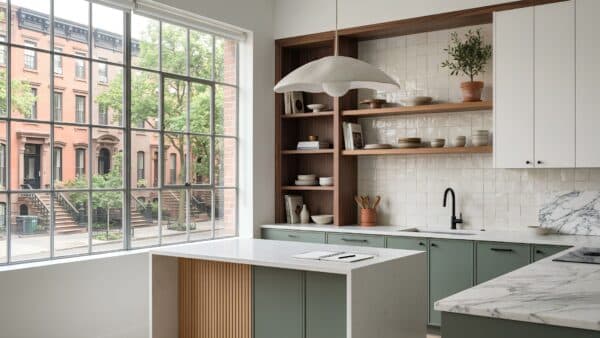
A showroom solves this problem. Model kitchens and bathrooms let you see how different cabinet styles actually look when installed. Material samples let you touch surfaces, compare finishes side by side, and evaluate quality.
MyHome’s Midtown showroom — just off 9th Avenue in Hell’s Kitchen — includes model kitchen and bathroom vignettes along with thousands of cabinet, countertop, tile, and fixture samples. Clients visit with their designer to compare options in person rather than making decisions based on catalog images.
From Inspiration to Selections — How Guided Decisions Work
The selection process at a full-service renovation company typically works like this:
Step 1: Share your inspiration. Bring your Pinterest boards, saved Instagram posts, magazine clippings, or photos of kitchens and bathrooms you’ve admired. Your designer uses these to understand your aesthetic preferences — even if you can’t articulate them yourself.
Step 2: Receive curated options. Based on your inspiration, budget, and space constraints, your designer presents a narrowed set of options. Not the entire catalog — just the selections that make sense for your specific project.
Step 3: Compare in person. You visit the showroom to see and touch the curated options. Your designer explains trade-offs (this countertop is more durable but costs more; this cabinet style is on trend but may date faster).
Step 4: Make confident decisions. Because you’re choosing from pre-vetted options with professional guidance, decisions feel manageable rather than overwhelming.
Clients describe this process as transformative. As one MyHome customer put it: “I’m not design savvy at all, but she had an amazing eye for detail and helped us pick materials that go together.”
When You Might Still Need a Separate Interior Designer
Quick take: If you’re pursuing an ultra-high-end aesthetic vision, want fully furnished interiors beyond the renovation scope, or are working with an architecture firm on a complex structural project, a standalone interior designer may add value.
Honesty matters here: not every project fits the design-build model perfectly.
If your renovation involves significant architectural changes — combining apartments, adding major structural elements, or working in a landmarked building with Landmarks Preservation Commission requirements — you may need an architect to lead the project. According to the NYC Department of Buildings, permits are required for work that involves gutting kitchens or bathrooms, moving plumbing or gas lines, making structural changes, or combining apartments.¹ In that case, some homeowners prefer hiring a separate interior designer who collaborates with the architect.
Similarly, if your vision extends beyond the renovation itself to include furniture selection, art curation, and full interior styling, a dedicated interior designer with that specialty may be appropriate.
But for most kitchen and bathroom renovations across Manhattan and Brooklyn — even extensive ones in pre-war co-ops on the Upper West Side or brownstones in Park Slope — the design help included with a full-service renovation company is sufficient.
Questions to Ask Any NYC Renovation Company About Design Help
Quick take: Before signing with any renovation company, ask specific questions about their design process. The answers reveal whether you’re getting genuine guidance or just a contractor who expects you to arrive with decisions already made.
Ask these questions:
- Do you have an in-house designer, or will I need to hire one separately?
- Can I visit a showroom to see cabinet, countertop, and fixture samples in person?
- How do you guide clients through material selections — what’s the process?
- What happens if I don’t know what style I want?
- Do I have to purchase materials through your company, or can I source my own?
On that last question: at MyHome, buying materials through our purchasing team is recommended for convenience (we handle ordering, stock, storage, and delivery), but it’s not required. Clients may source their own materials if they prefer.
Vague answers to these questions — or any suggestion that selections are “your responsibility” — indicate you’re talking to a contractor, not a design-build firm. That’s not inherently bad, but it means you’ll need to hire design help elsewhere or manage selections yourself.
Additionally, verify that any renovation company you’re considering is properly licensed. In New York City, home improvement contractors must be licensed through the Department of Consumer and Worker Protection.²
What to Expect Cost-Wise
Quick take: Design-build firms typically include design services in your overall project scope rather than charging separately. This often costs less than hiring an architect, a separate interior designer, and a contractor independently.
At a traditional contractor-only arrangement, you might pay an interior designer separately — fees typically range from a fixed rate based on square footage to hourly consultation charges, plus percentage markups on any materials they source for you. These costs add up quickly when you’re also paying an architect and a general contractor, each sending separate invoices.
Design-build firms bundle design into the project scope. You receive one itemized proposal covering design, materials, permits, and construction — not separate invoices from multiple professionals.
The total cost isn’t necessarily lower (design-build firms aren’t budget contractors), but the value is clearer: you know what you’re paying for, you have one team accountable for the outcome, and you’re not spending your evenings coordinating three different professionals who’ve never worked together.

How MyHome Guides Design Selections — From Showroom to Installation
Quick take: MyHome pairs every client with an in-house designer, offers a Midtown showroom with thousands of samples, and manages the entire process from design through installation with three named points of contact.
At MyHome, you work with three people throughout your project: a Renovation Expert who assesses your space and provides an itemized proposal, a Designer who guides all material selections, and a Project Manager who oversees construction. This isn’t a rotating cast of strangers — it’s a defined team you’ll know by name.
Our Midtown showroom features model kitchens and bathrooms where you can experience different layouts and styles. Thousands of cabinet, countertop, and fixture samples let you compare options with your designer’s guidance.
With 25 years renovating kitchens and bathrooms across Manhattan and Brooklyn — from Upper East Side co-ops to Chelsea condos to Brooklyn Heights brownstones — we understand both the design challenges and the building-approval complexities unique to NYC apartments. We’ve never been turned down by a residential building, and we handle your building’s approval process alongside the design and construction so you’re not managing multiple workstreams.
Every project receives an itemized labor proposal before any commitment, outlining the recommended scope of work and pricing. You see exactly what’s included, transparent upfront.
Learn more about our kitchen remodeling process, explore our interior design services, or see how we guide renovations from design through installation.
FAQ — Design Help for NYC Renovations
Do renovation companies help you pick cabinets and countertops, or is that my job?
Full-service design-build firms include in-house designers who guide these selections. Traditional contractors expect you to arrive with decisions made or hire design help separately.
What’s the difference between an interior designer and the design help a renovation company provides?
A standalone interior designer works independently and coordinates with your contractor. An in-house designer at a design-build firm is part of the same team that builds your renovation, ensuring design and construction stay aligned.
Can I see cabinet and countertop samples before making final decisions?
At companies with showrooms, yes. This is one of the most important questions to ask — seeing and touching materials in person prevents costly mistakes.
What if I don’t know what style I want?
A good designer will help you discover your preferences through questions about your lifestyle, inspiration images, and reactions to sample materials. You don’t need to arrive knowing what you want.
Not Design-Savvy? Book a Free Design Consultation.
If you’re planning a kitchen or bathroom renovation in Manhattan or Brooklyn and don’t know where to start with design decisions, we can help. Book a free design consultation to meet with a MyHome Renovation Expert, discuss your project, and learn how our in-house designers guide every selection — from cabinets and countertops to the finishing details that make your renovation feel complete.
You can also visit our Midtown showroom to see model kitchens and bathrooms and explore our project gallery to see completed renovations across Manhattan and Brooklyn.
Call us at 212.666.2888 or request your free estimate online.
Sources
- NYC Department of Buildings. “Alterations and Renovations.” https://www.nyc.gov/site/buildings/homeowner/alterations-renovations.page
- NYC Department of Consumer and Worker Protection. “Home Improvement Contractor License.” https://www.nyc.gov/site/dca/businesses/license-checklist-home-improvement-contractor.page

Yoel Piotraut
Yoel Piotraut is the Founder of MyHome Renovation Experts, a New York City renovation company that has completed complete-apartment, kitchen, and bathroom renovations across Manhattan and Brooklyn for 25 years. He works closely with co-op and condo owners on building approvals, alteration agreements, and the realities of renovating occupied NYC apartments. Connect with Yoel on LinkedIn: https://www.linkedin.com/in/yoelpiotraut/
Related Posts
How to Choose a Renovation Company for Your NYC Co-op: The 8 Questions That Separate Great Contractors from Expensive Mistakes
Learn how to choose a co-op renovation company in NYC. 8 critical questions covering board...

What Your Contractor Should Handle So Your Co-op or Condo Board Approves Your NYC Renovation
Learn what your NYC renovation contractor should handle—alteration agreements, insurance, board liaison—so your co-op or...
What NYC Co-op Renovations Actually Cost—And How to Avoid Budget Surprises
Learn what NYC co-op renovations cost in 2025. Get real price ranges for kitchens, bathrooms,...